
Is Color Trading Legal in India in 2026?
Colour betting under India's gaming law
Is color trading legal in India? For the version most people mean, where you stake money on a colour and hope to get a multiple back, the position since 1 May 2026 is clear for anyone who runs it, advertises it or moves its payments: the law prohibits it. This page sets out why, using the wording of the law and dated news reports. It is written for adult readers and it is not legal advice. We are an independent guide, separate from every operator of these games, and we do not run any gaming service ourselves.
What the 2025 Act actually covers
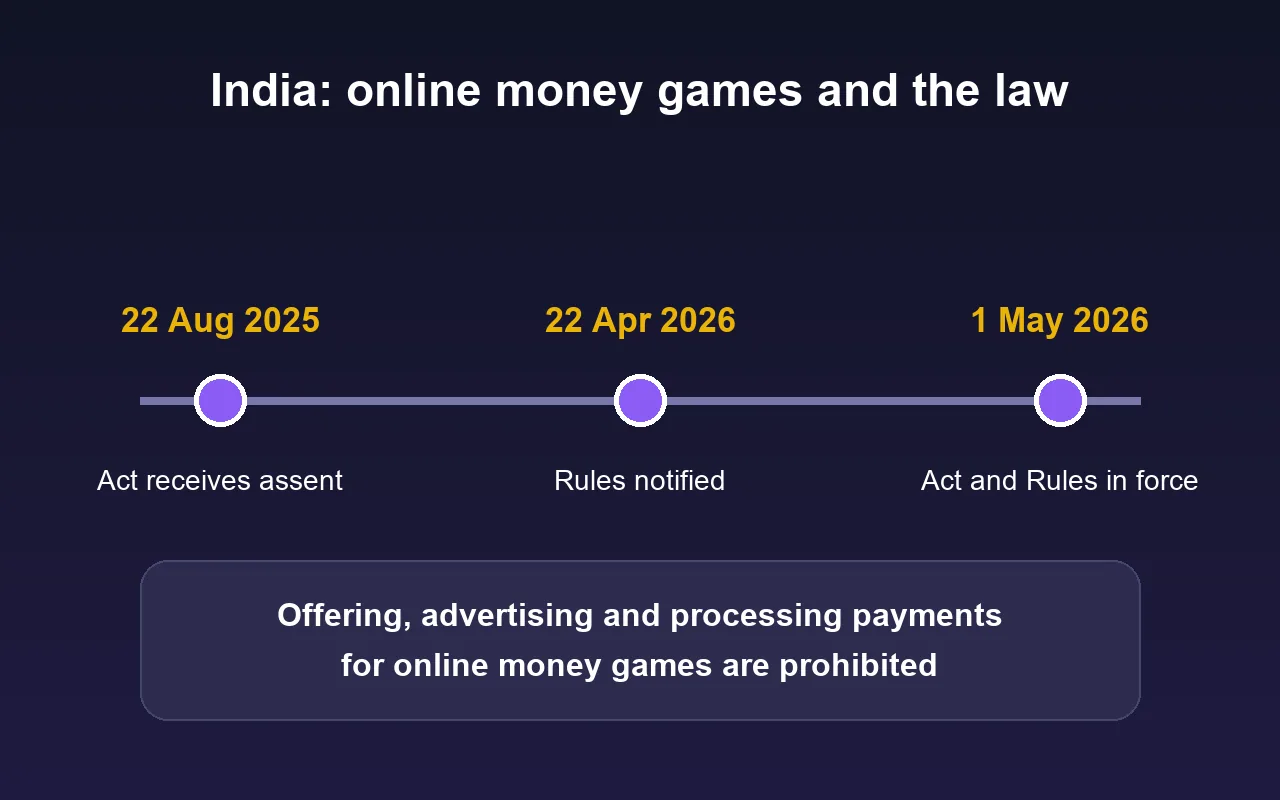
The law in question is the Promotion and Regulation of Online Gaming Act, 2025. Its Rules for 2026 were notified on 22 April 2026 and took effect on 1 May 2026. The Act treats online money games as a separate category from other online games, and it defines that category broadly. Put simply:
- An online money game is any online game where the user pays money or puts up a stake expecting monetary gain in return.
- Whether the outcome rests on skill, chance or a mix of the two makes no difference.
- Coins, credits or points that can be turned into money count as stakes as well.
- Offering such a game, advertising it and facilitating payments for it are all prohibited.
- The government can order content linked to such games to be blocked.
Offering such games and facilitating their payments are cognisable and non-bailable offences under the Act. We leave the punishment figures out on purpose. What a reader needs to take away is that the law treats this as criminal conduct, not as a licensing formality that a platform can fix with the right paperwork.
Does a colour round meet that definition?
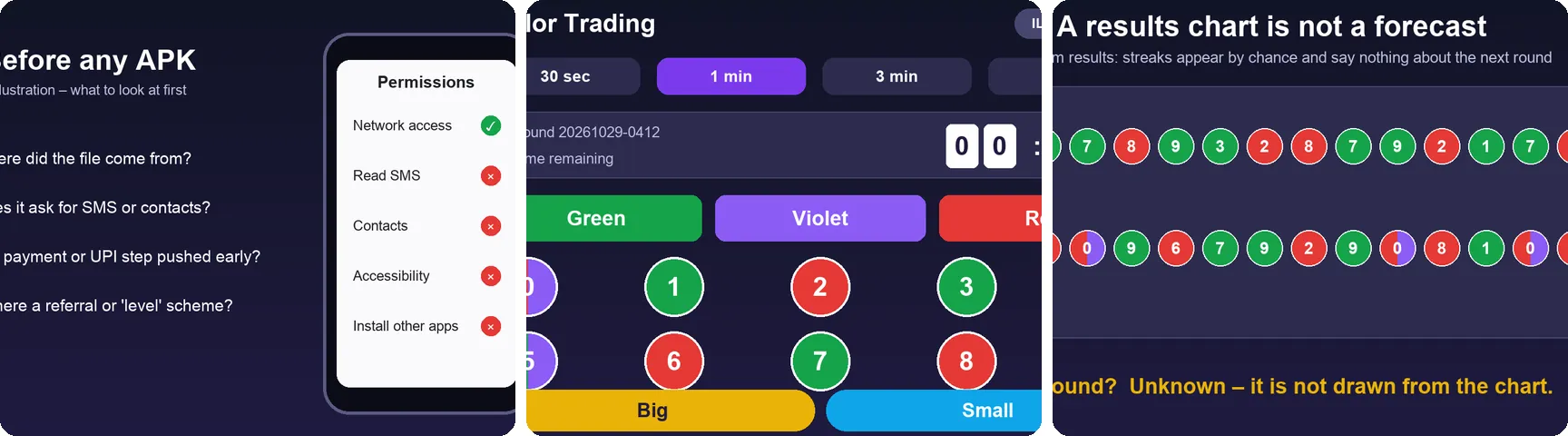
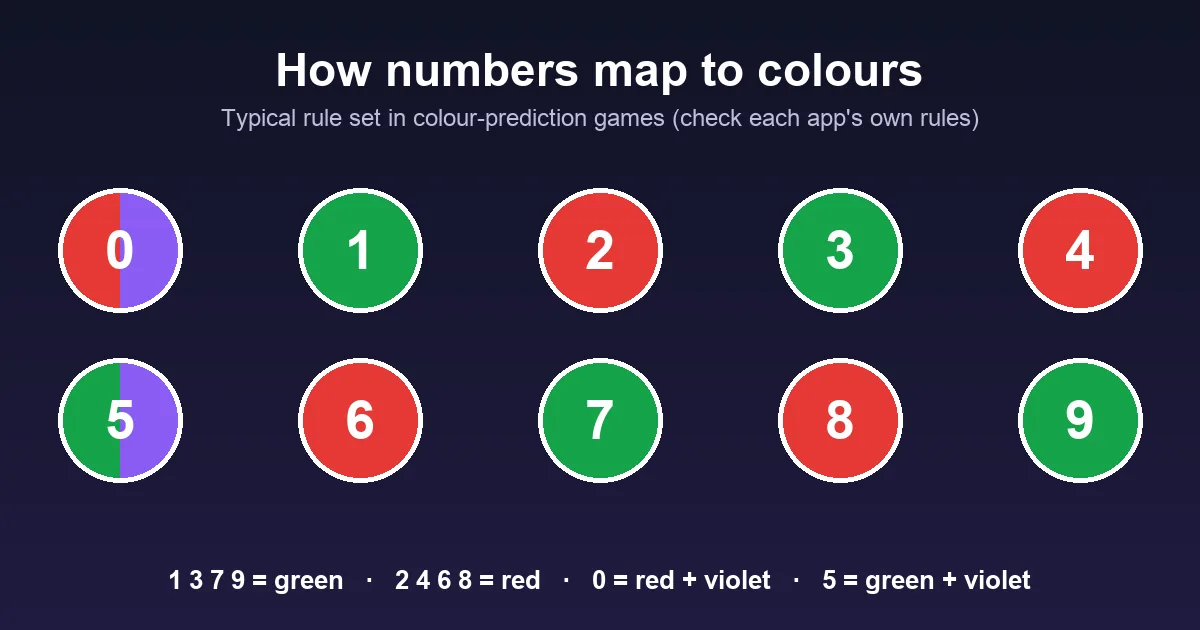
Start with how a typical round is presented. Apps of this kind usually show a countdown, often somewhere between thirty seconds and a few minutes, and three colours: red, green and violet. Many add the digits 0 to 9, with each digit linked to a colour and to Big (5 to 9) or Small (0 to 4). The player stakes money on one of these outcomes, and a correct guess pays a multiple of the stake. Each app sets its own rules, so the details shift from one platform to the next, yet the core never changes: money goes in, the platform's software picks the result, and money comes back only when the guess matches.
That core matches the Act's wording closely. We found no government notice that names colour prediction specifically, so treating it as an online money game is an inference from the definition. It is a strong one, because the definition does not care how a game looks; it asks whether money is staked in the hope of more money. A SEBI-registered broker's education blog has also described colour trading as gambling rather than trading, and noted that neither SEBI nor the RBI regulates it.
Who the prohibition reaches first
The Act turns on three verbs: offer, advertise and facilitate. Each one fits a link in the chain behind a typical color trading website. The operator offers the game. Recruiters, channels and influencers who push referral links are advertising it, and these apps have long paid users for signing up new players. Banks, wallets and payment gateways that carry deposits would be facilitating it, which is why the law bars payment systems from processing such transactions. In practice the payment rule bites hardest, because a betting service that cannot collect money through regular channels has very little to run on.
If an app asks you to pay into an individual's account rather than a named business, read that as a reason to stop. It is not a clever workaround; it simply means nobody accountable is standing behind the transaction.
Where that leaves the player
The facts we could verify concern providers, promoters and payment handlers. We are not aware of a separate offence written for ordinary players, and we do not give an opinion on that point. Absence of a player offence is not the same as permission, though. Asking "is color trading legal in India?" from the player's seat leads to an awkward answer: anyone who joins after 1 May 2026 is depositing into a service that should not be offered here, through payment routes the law tells banks to shut, with no regulator to turn to if a withdrawal is refused. The legal reading and the practical reading arrive at the same place. Nothing protects the money once it leaves your bank account.
What happened before the Act
The ban did not come out of nowhere. In August 2020 Hyderabad police broke up a colour-prediction betting racket, arresting a Chinese national at IGI Airport in Delhi along with three other men; money was allegedly laundered to accounts in Singapore, and the Enforcement Directorate opened a money-laundering probe. In 2021 The News Minute reported users in Bengaluru and Chennai who could not withdraw balances shown in their wallets, one of them above seven lakh rupees, and who were told to deposit more first. Their police complaints went slowly. An analyst traced 60 such sites to IP addresses in China.
By December 2021, Telangana cybercrime officials put the number of active betting apps of this type at nearly 2,000. They said operators used fake IP addresses, victims received calls from Hong Kong numbers, and links spread through SMS, WhatsApp and social media. Telangana already banned such games at the time. The 2025 Act now adds one national rule on top of that state-level picture.
The part the Authority still decides
Under the 2026 Rules, the Online Gaming Authority of India decides whether a particular game counts as an online money game and publishes a list. That list is the document to watch. Until a format or an app is dealt with there, any claim that one platform is approved, registered or allowed deserves real suspicion. We found no official notice clearing any colour-prediction app, and we do not label any app safe or unsafe on this page. The same caution applies to pages ranking for searches like "color trading login" that promise a fast sign-in. A login screen proves only that someone built a login screen; it says nothing about whether the service behind it may operate in India.
If you are thinking of playing anyway
This guide is for adults, 18+ only. If you already hold an account, settle on a total you are ready to lose, write the number down and stop when you reach it, instead of depositing again to win back what is gone. Keep OTPs, UPI PINs and ID documents away from agents and chat groups. If betting has begun to affect your sleep, your money or the people around you, Tele-MANAS on 14416 (or 1-800-891-4416) offers free, confidential support. Our scoring of this topic sits in the rating section, and shorter answers are in the FAQ.
What this law guide asks of you
Personal details: There is no sign-up form, account or chat here. Every section can be read without giving a name, number or ID.
Cookies: Only what the privacy page lists. This page never asks for your location, contacts, camera or microphone.
The Play button: It opens an external page chosen by the site owner. Whatever you type there is handled by that page, not by this guide.
KYC requests elsewhere: Before giving PAN, Aadhaar or bank details to any app, ask who holds them and under which law. No clear answer means no documents.
Phone permissions: Apps sent as files skip store checks. Refuse access to SMS, contacts or screen recording that a betting screen has no need for.


Our editorial score for the legal angle
What works
- The round format is short and simple to follow on paper
- Public reporting on the genre goes back to 2020 with named sources
- The 2025 Act gives one clear national definition to test against
What to keep in mind
- Paid play fits the Act's prohibited online money game definition
- Results come from platform software that no player can check
- Withdrawal complaints from 2021 show money can get stuck in wallets
Law questions readers send us
Can a player be arrested for joining a colour prediction app?
The offences we could verify in the Act are aimed at those who offer these games, advertise them or facilitate their payments. We are not aware of a separate offence written for ordinary players, and this is not legal advice. That still leaves a player sending money to a service that should not operate in India, with no regulator to help if the balance never comes back.
Does the gaming law name colour prediction anywhere?
Not that we could find. The Promotion and Regulation of Online Gaming Act, 2025 defines an online money game as any online game where users stake money expecting monetary gain, whatever the mix of skill and chance. Paid colour prediction fits that wording. The Online Gaming Authority of India, set up under the 2026 Rules in force from 1 May 2026, publishes the list of games it has classified.
Does a server outside India put an app beyond the law?
It does not make the app any safer for you. An analyst in 2021 traced dozens of such sites to IP addresses in China, and Telangana officials described operators hiding behind fake IP addresses. The Act lets the government block content, and it bars Indian banks and payment systems from processing money-game payments. A foreign base mostly makes complaints and refunds harder to pursue.
Is colour trading regulated like share trading?
No. Despite the word trading, nothing is bought or sold. A SEBI-registered broker's education blog notes that neither SEBI nor the RBI regulates colour trading and calls it gambling. There is no exchange, no investor protection and no settlement system behind a round, only a platform deciding a result and paying out according to rules it set itself.
What should I do if an app holds back my balance?
Do not send more money to release it. In 2021, users in Bengaluru and Chennai were told to deposit again before any withdrawal, and that did not get their money out. Keep screenshots of the balance, transactions and chats, stop playing, and report the matter at your local police station or through the national cybercrime reporting portal.
Is a free, points-only colour game covered too?
The Act looks at stakes. Coins and credits that can be converted into money count as stakes, so a points game with a cash-out route falls under the same definition as a paid one. A version with no payment in and no way to convert points into money would not match that definition as we read it, though the Authority has the final word on classification.